
5 min read
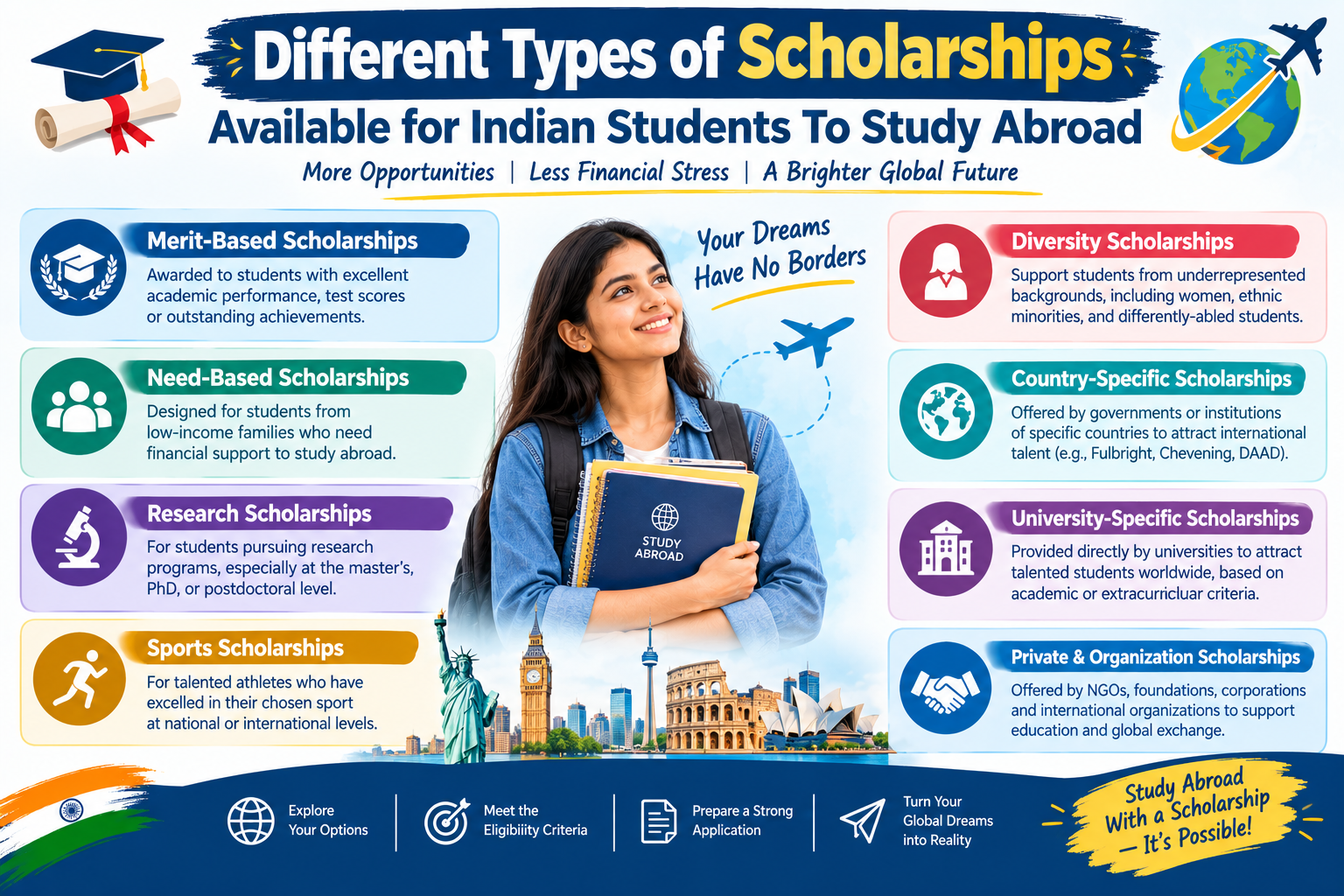
Different Types of Scholarships Available for Indian Students to Study Abroad (2026 Guide)
By Subraxo Editorial Team. Last updated 23 September 2026.
The main types of scholarships available for Indian students to study abroad are:
1. Indian government scholarships (such as the National Overseas Scholarship)
2. Foreign government scholarships (such as Chevening, Fulbright-Nehru, DAAD and MEXT)
3. University scholarships (merit awards, tuition waivers and department awards)
4. Research funding for PhD and research master's students (assistantships and studentships)
5. Private trust and foundation scholarships (such as Inlaks and Tata)
6. Loan scholarships and interest-free study grants (such as J.N. Tata Endowment)
7. Partnership scholarships run by bodies like the British Council (such as GREAT Scholarships)
8. Merit, need, category, subject and women-focused scholarships within each of these groups
Every study abroad scholarship an Indian student can apply for falls into one of these groups, and each group has its own funder, selection logic, timeline and level of competition. Knowing which type fits your profile is the fastest way to stop scrolling through endless lists and start applying where your odds are real.
How Scholarships for Indian Students Are Classified
Most scholarship lists online throw 50 names at you in no particular order. That is where students get lost. A more useful way to think about it is that every scholarship can be described along four lines:
• Who pays for it: an Indian government ministry, a foreign government, a university, a private trust, or a partnership between them.
• Why it is awarded: academic merit, financial need, community or category, subject area, gender, leadership, or talent in sports and the arts.
• What it covers: everything (fully funded), full tuition, part of the tuition, a fixed cash amount, or an interest-free loan.
• How you get it: automatically with admission, through a separate application, or only after being nominated by an institution or ministry.
Once you know where a scholarship sits on these four lines, you know who you are competing against, what the committee wants to see, and when you need to apply.
Type of scholarship | Funded by | Usually covers | Competition | Best suited to |
Indian government scholarships | Central or state ministries | Tuition, living costs, airfare | Medium (eligibility is narrow) | Students from eligible communities with limited family income |
Foreign government scholarships | Governments of the UK, USA, Germany, Japan and others | Often fully funded | Very high | Postgraduates with strong academics, leadership or work experience |
University scholarships | The university you apply to | Partial to full tuition | Low to medium | Almost every admitted student with a good profile |
Research funding | Universities, research councils, supervisors | Tuition plus a monthly stipend | Medium to high | PhD and research master's applicants |
Private trust and foundation scholarships | Indian trusts, foundations, corporates | Fixed grants or partial costs | Medium | Students at top-ranked universities, specific subjects or need-based cases |
Loan scholarships | Trusts and endowments | Interest-free or low-cost loans | Medium | Students who need funding but miss out on grants |
Partnership scholarships | British Council, universities, embassies | Fixed tuition amount | Medium | Students targeting a specific country or university |
1. Indian Government Scholarships to Study Abroad
These are funded by the Government of India or a state government. They are generous, but eligibility is tightly defined, usually by community, family income and academic score. That narrow eligibility is also their biggest advantage: if you qualify, you are competing within a much smaller pool.
National Overseas Scholarship (NOS)
The National Overseas Scholarship is run by the Ministry of Social Justice and Empowerment for Master's and PhD students from Scheduled Castes, Denotified, Nomadic and Semi-Nomadic Tribes, Landless Agricultural Labourers and Traditional Artisan families. The 2026-27 guidelines provide 125 fresh awards, with 30 percent reserved for women, and require a family income of up to Rs 8 lakh a year, at least 60 percent in the qualifying degree, and an unconditional offer from a university in the QS World University Rankings top 500.
Students from Scheduled Tribes apply under a separate National Overseas Scholarship run by the Ministry of Tribal Affairs, through its own portal.
State government overseas scholarships
Several state governments run their own study abroad schemes, usually for minority, backward class or economically weaker students domiciled in that state. These are often less competitive than central schemes because fewer students know about them.
Who this type suits
• Students from eligible communities with family income within the scheme's limit.
• Students who have already secured admission to a well-ranked university, since most schemes require the offer first.
• Applicants who can keep income, caste and domicile certificates valid and consistent throughout the process.
2. Foreign Government Scholarships for Indian Students
These are the famous names, funded by foreign governments to build long-term ties with future leaders. Most are fully funded and focused on postgraduate study, and almost all are highly competitive.
Scholarship | Country | Level | What makes it distinct |
Chevening Scholarships | UK | One-year master's | Needs work experience and a commitment to return to India after the course |
Commonwealth Scholarships | UK | Master's and PhD | Indian applicants are nominated through the Ministry of Education, and development impact is central |
Fulbright-Nehru Fellowships | USA | Master's, doctoral research | Aimed at professionals, with a focus on leadership and public service |
DAAD Scholarships | Germany | Master's, PhD, research stays | Many programmes, including development-related courses that need work experience |
Erasmus Mundus Joint Masters | Europe | Master's | Study in two or more European countries with one scholarship |
MEXT Scholarship | Japan | Undergraduate, master's, research | Applied through the Embassy of Japan or through a Japanese university |
Global Korea Scholarship (GKS) | South Korea | Undergraduate, master's, PhD | Includes a funded year of Korean language study |
Australia Awards | Australia | Master's | India's intake has run through nominations from selected Indian institutions |
Eiffel Excellence Scholarship | France | Master's, PhD | You are nominated by the French institution, not by applying directly |
A detail most lists skip: foreign government scholarships reward a story, not just marks. Chevening looks for leadership and networking, Commonwealth looks for development impact at home, and Fulbright-Nehru looks for professional contribution. A 9.5 CGPA with no clear plan for the future usually loses to an 8.0 with a convincing one.
Who this type suits
• Postgraduate applicants with two or more years of meaningful work experience.
• Students with a clear plan to apply what they learn back in India.
• Applicants who can start preparing 10 to 12 months before the course begins.
3. University Scholarships for International Students
This is the largest and most underrated group. Nearly every university abroad sets aside money for international students, and Indian applicants are among the biggest groups competing for it. The amounts vary from a small tuition discount to a full fee waiver.
Automatic merit scholarships
Many universities in the UK, Australia, Canada and Ireland review your academic record at admission and apply a scholarship automatically, often as a percentage or fixed reduction in tuition. You do not write a separate essay. The catch is that some of these are only available if you apply before an early or priority deadline.
Application-based university scholarships
These need a separate application, usually an essay and sometimes an interview. Examples include vice-chancellor's awards, global excellence scholarships and dean's awards. Competition is real but far smaller than for government awards.
Department and course-specific scholarships
Individual departments and schools often fund students in their own subjects. These rarely appear on central scholarship pages, so students who dig through department websites have a genuine edge.
Need-based aid in the USA
A small number of US universities meet the demonstrated financial need of international undergraduates. Some universities also run dedicated funds for Indian students, such as the Tata Scholarship for Indian undergraduates at Cornell University. These are extremely competitive, but they are one of the few routes to a fully funded undergraduate degree abroad.
Who this type suits
• Undergraduate and postgraduate students with a solid academic profile.
• Students who apply early in the admission cycle.
• Anyone who wants realistic, stackable funding rather than a single all-or-nothing bet.
4. Research Funding: Assistantships, Studentships and Fellowships
PhD funding works differently from coursework funding. In many countries, a funded PhD is the norm rather than the exception.
• Teaching and research assistantships (USA): You teach or assist in research for a set number of hours a week, and in return receive a tuition waiver and a monthly stipend.
• Funded PhD positions (Germany, the Netherlands, the Nordic countries): Many doctoral students are hired as salaried researchers on a contract.
• Studentships (UK): Research councils and universities fund tuition and a living stipend for a fixed number of years.
• Prestigious fellowships: Awards such as Gates Cambridge, Rhodes and Knight-Hennessy fund graduate study at Cambridge, Oxford and Stanford respectively.
The key difference is that your supervisor and research proposal often matter as much as your grades. Emailing potential supervisors early is part of the application, not an optional extra.
5. Private Trust and Foundation Scholarships for Indian Students
Indian trusts, foundations and corporates run some of the most valuable scholarships available to Indian students, and they are open only to Indians, which shrinks the applicant pool considerably.
Scholarship | Type | Key feature |
Inlaks Shivdasani Foundation Scholarships | Grant | For Indian students under 30 heading to top universities in the USA, UK and Europe |
Tata Scholarship at Cornell University | Need-based grant | For Indian undergraduates admitted to Cornell |
Reliance Dhirubhai Fellowship | Fellowship | For Indian students pursuing an MBA at Stanford Graduate School of Business |
Aga Khan Foundation International Scholarship | Half grant, half loan | For postgraduate students from selected developing countries, including India |
Charles Wallace India Trust Scholarships | Grant | For Indian students in the arts, heritage and humanities in the UK |
Most of these require admission to a well-ranked university first, and several interview shortlisted candidates. Their deadlines often fall in the first half of the year for courses starting that autumn, which is later than government scholarships but still easy to miss.
6. Loan Scholarships and Interest-Free Study Grants
This category confuses many students, but it is worth understanding. A loan scholarship gives you money that you repay, usually without interest or on very generous terms, and it often comes with the prestige and network of a scholarship.
• J.N. Tata Endowment: Offers loan scholarships to Indian graduates for higher studies abroad, along with a travel grant for some scholars.
• K.C. Mahindra Education Trust: Offers interest-free loan scholarships for postgraduate study abroad, with a few outstanding scholars receiving larger awards.
• Narotam Sekhsaria Foundation: Offers interest-free loan scholarships for postgraduate study in India and abroad.
How a loan scholarship differs from an education loan
A loan scholarship is selected on merit and usually carries little or no interest, but amounts are capped and seats are limited. An education loan from a bank or NBFC can cover the full cost of study but carries interest. Many students use both: the loan scholarship reduces the amount they need to borrow, and an education loan covers the rest.
7. Partnership Scholarships Run by Organisations Like the British Council
Some scholarships are jointly funded by a government body and universities. The best-known example for Indian students is the GREAT Scholarships programme. For 2026-27, the British Council and the UK government's GREAT Britain campaign, together with participating universities, offered 12 postgraduate scholarships to students from India, each worth at least £10,000 towards tuition for a one-year taught master's.
Embassies and cultural bodies of other countries run similar programmes from time to time, often tied to a specific university or subject. They are small in number, but very few students apply for them, which makes them worth tracking.
Scholarships Based on Merit, Need, Category and Subject
Within all of the groups above, scholarships are also classified by why they are awarded. This tells you how to write your application.
Basis of award | What the committee looks for | How to present yourself |
Merit-based | Grades, test scores, awards, research | Lead with results and rankings |
Need-based | Family income and the funding gap | Show a clear, documented budget and what you can contribute |
Merit-cum-need | Strong academics and genuine need | Balance achievement with financial evidence |
Category or community-based | Membership of an eligible group | Keep certificates valid and consistent across documents |
Subject-specific | Fit with a field such as STEM, public health or climate | Show commitment to the field through projects and experience |
Women-focused | Women in underrepresented fields | Highlight leadership and your plans in the field |
Leadership and impact | Initiative and influence on others | Use concrete examples with measurable outcomes |
Sports and arts | Talent and achievement | Provide portfolios, rankings and recognitions |
Fully Funded vs Partially Funded Scholarships
"Fully funded" is the most searched phrase in this space, but it is also the most misunderstood.
Coverage type | What it usually includes | How common it is |
Fully funded | Tuition, living allowance, airfare, insurance, sometimes visa costs | Rare, mostly government and elite fellowships |
Full tuition waiver | Tuition only, you pay living costs | Uncommon |
Partial tuition scholarship | A percentage or fixed reduction in tuition | Very common |
Fixed grant or bursary | A one-time or yearly cash amount | Common |
Stipend or assistantship | A monthly payment, often with a tuition waiver | Common at PhD level |
Loan scholarship | Interest-free or low-interest funding you repay | Limited but valuable |
The practical lesson: a few partial scholarships added together can close most of your funding gap, while waiting for a single fully funded award can leave you with nothing. Apply for one or two fully funded scholarships, but build the rest of your plan around university and private awards.
Which Type of Scholarship Should You Apply For?
Use your own profile to decide where to focus your time.
Your profile | Scholarship types to prioritise |
Class 12 student going abroad for an undergraduate degree | University merit scholarships, US need-based aid, MEXT and GKS undergraduate tracks |
Final-year student or fresh graduate applying for a master's | University scholarships, GREAT Scholarships, Erasmus Mundus, private trusts |
Working professional with 2 or more years' experience | Chevening, Fulbright-Nehru, Commonwealth, DAAD development programmes |
PhD applicant | Assistantships, funded PhD positions, Commonwealth PhD, prestigious fellowships |
Student from an eligible community with limited income | National Overseas Scholarship, state schemes, need-based university aid |
Student admitted to a top 50 university | Inlaks, Tata and other Indian trusts, loan scholarships |
When to Apply for Each Type of Scholarship
Different types of scholarships follow different calendars. For a September intake, a typical pattern looks like this:
Scholarship type | When applications usually open or close |
Foreign government scholarships | 9 to 12 months before the course begins |
Indian government schemes | After you hold an admission offer, often in the months before the intake |
University scholarships | Alongside admission, often with early or priority deadlines |
Private trusts and loan scholarships | Usually in the first half of the year the course begins |
Research funding | 8 to 12 months before the start date, often after contacting supervisors |
Always confirm dates on the official scholarship website, as they change from year to year.
How Subraxo Helps You Find and Fund the Right Scholarships
Knowing the types of scholarships is step one. Finding the ones you actually qualify for, meeting their deadlines and funding the gap is where most students need help.
• Scholarship matching: Subraxo's scholarship search filters awards by your country, course, level and profile, including university and trust awards that rarely appear on popular lists.
• Planning your timeline: Our team maps scholarship deadlines to your admission timeline, so government and early-round university awards are not missed.
• Covering the gap with the right loan: As an official partner of 14+ banks, Subraxo helps you compare education loan options, so a scholarship and a loan work together and you borrow only what you need.
• Zero service fee: Students do not pay Subraxo for this support.
[Editor: add the verified credibility line here, e.g. MeitY support, NITI Aayog recognition, AICTE MoU, number of students funded and amount disbursed. Delete this note before publishing.]
Find scholarships you are eligible for
FAQs on Scholarships for Indian Students to Study Abroad
What are the main types of scholarships for Indian students to study abroad?
The main types are Indian government scholarships, foreign government scholarships, university scholarships, research funding for PhD students, private trust and foundation scholarships, loan scholarships and partnership scholarships such as GREAT Scholarships. Each type differs in who funds it, what it covers and how competitive it is.
Which is the easiest type of scholarship to get for studying abroad?
University scholarships are usually the most accessible, since many are awarded automatically at admission based on your academic record. Department-level awards and smaller private scholarships also attract fewer applicants. Fully funded government scholarships are the hardest, because thousands of strong candidates compete for a limited number of places.
Are there fully funded scholarships for Indian students?
Yes. Chevening, Commonwealth, Fulbright-Nehru, DAAD, Erasmus Mundus, MEXT, GKS and the National Overseas Scholarship can cover tuition, living costs and travel. They are highly competitive and mostly for postgraduate study, so apply for them alongside university scholarships rather than relying on one award.
What is the difference between merit-based and need-based scholarships?
Merit-based scholarships reward academic results, test scores, research or achievements, regardless of income. Need-based scholarships consider your family's financial situation and the gap between your costs and resources. Some awards combine both. The basis of the award should shape your application, from what you highlight to the documents you submit.
Does the Indian government give scholarships to study abroad?
Yes. The Ministry of Social Justice and Empowerment runs the National Overseas Scholarship for eligible communities with family income up to Rs 8 lakh a year, and the Ministry of Tribal Affairs runs a separate scheme for Scheduled Tribe students. Several state governments also offer overseas scholarships for students domiciled in the state.
Can I get a scholarship to study abroad after Class 12?
Yes, though undergraduate options are fewer than postgraduate ones. Look at university merit scholarships, need-based aid at US universities that support international students, and government schemes like MEXT and GKS that have undergraduate tracks. Strong academics, extracurricular achievements and a well-written personal statement matter most.
What is a loan scholarship?
A loan scholarship provides funding that you repay later, usually interest-free or on very generous terms. Examples include the J.N. Tata Endowment, K.C. Mahindra Education Trust and Narotam Sekhsaria Foundation. They are selected on merit, carry scholarship prestige, and can reduce how much you need to borrow through an education loan.
Can I apply for more than one type of scholarship?
Yes, and you should. Most students apply for a mix of government, university and private awards. Some fully funded scholarships do not allow you to hold another major award at the same time, so read each scholarship's terms before accepting, and inform the funders if you receive more than one award.
Do I need an admission offer before applying for a scholarship?
It depends on the type. University scholarships are linked to your admission application. The National Overseas Scholarship and most private trusts require an offer before or during the scholarship process. Some foreign government scholarships let you apply before securing admission, but you must hold an offer before the award is confirmed.
Are there scholarships only for Indian women studying abroad?
Yes. Several universities, foundations and corporate programmes offer scholarships for women, especially in STEM, business and leadership. The National Overseas Scholarship also reserves 30 percent of its awards for women. Check each scholarship's eligibility carefully, as many women-focused awards are subject-specific or limited to certain countries.
Can a scholarship and an education loan be used together?
Yes. Most students combine the two. The scholarship reduces the total amount needed, and the education loan covers the remaining tuition and living costs. Keep your scholarship letter, loan sanction letter and visa funds proof consistent, and inform your lender if you win an award after your loan is sanctioned.
When should I start applying for scholarships to study abroad?
Start about 12 months before your intake. Foreign government scholarships often close 9 to 12 months ahead, university scholarships run alongside admissions, and private trusts usually open in the first half of the year your course begins. Starting early lets you target every type of scholarship instead of only the ones still open.
Conclusion
Scholarships for Indian students to study abroad come from governments, universities, trusts and partnerships, and each type rewards something different. Start by identifying the two or three types that match your profile, apply early, and combine partial awards with the right education loan. That is how most students actually fund their degree abroad.