
6 min read
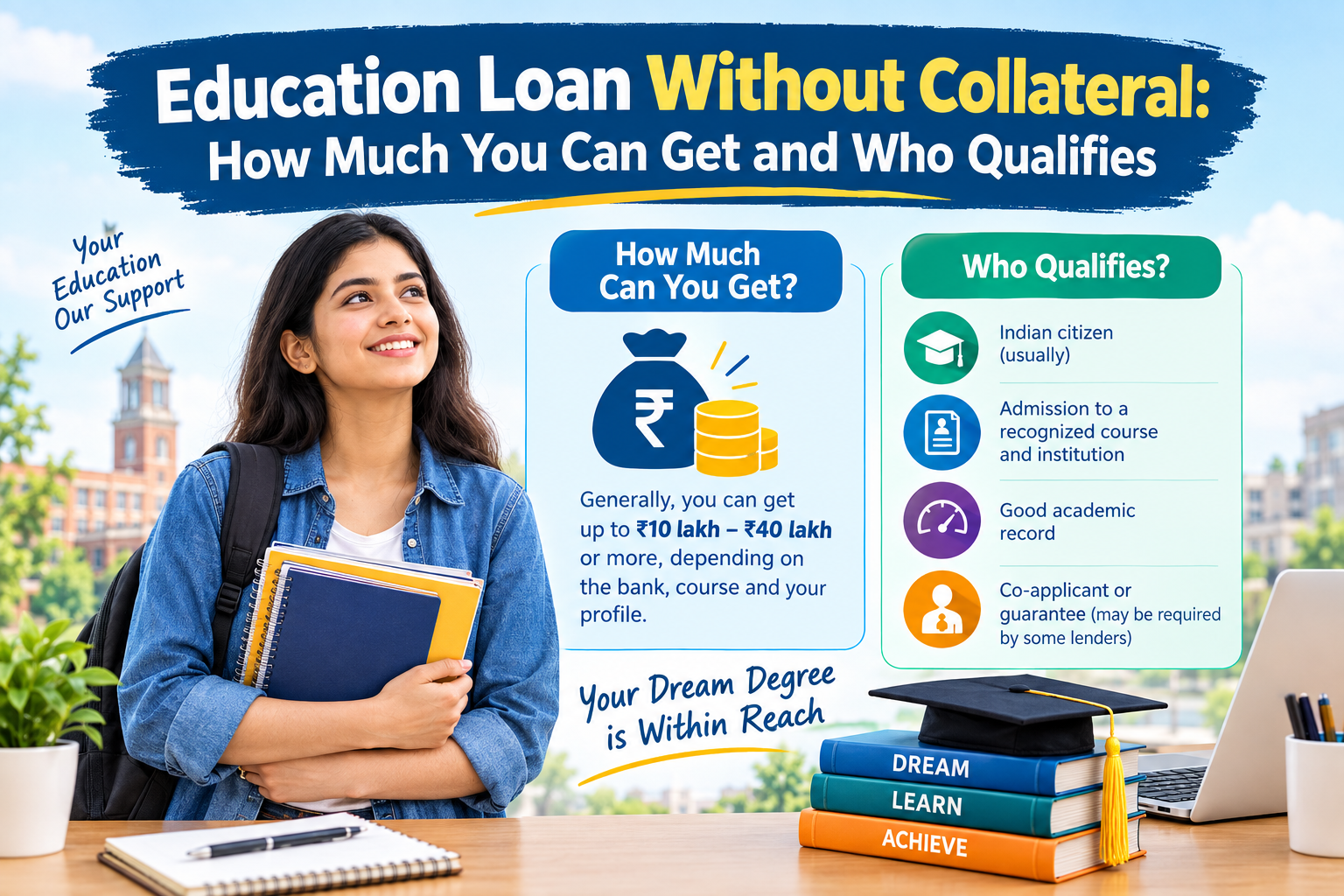
Education Loan Without Collateral: How Much You Can Get and Who Qualifies
By Subraxo Editorial Team. Last updated 23 September 2026.
How much you can borrow as an education loan without collateral in India, by route:
- Up to Rs 7.5 lakh from most banks, backed by the government's credit guarantee scheme
- Collateral-free and guarantor-free loans for students at eligible Indian institutions under PM-Vidyalaxmi
- Up to Rs 50 lakh from SBI for students admitted to around 100 premier foreign universities on its approved list
- Higher unsecured amounts from private banks and NBFCs for strong university and co-applicant profiles
- Loans with no collateral and no co-applicant from international lenders, for students at the universities they support
Who qualifies for an education loan without collateral depends on three things: your university, your course and your co-applicant's credit profile. A student admitted to a top-ranked university with a co-applicant who has steady income and a clean credit record can often borrow the full cost of study without pledging anything. This guide shows you where you stand and how to get the most from an unsecured loan.
What Is an Education Loan Without Collateral?
An education loan without collateral, also called an unsecured education loan or collateral-free education loan, is a loan where you do not pledge property, fixed deposits or other assets as security. If the loan is not repaid, the lender cannot sell a specific asset to recover it.
Instead, the lender relies on three things:
- The student's future earning potential, judged by the university, course and country.
- The co-applicant's income and credit history, usually a parent or guardian who shares repayment responsibility.
- In some cases, a government guarantee that covers part of the lender's loss if the loan defaults.
Collateral-free does not mean risk-free
With no collateral, the co-applicant is still fully liable for the loan, and a default damages the credit record of everyone on it. Many lenders also ask for a term insurance policy on the student to be assigned to them, and some take an assignment of the student's future income. You are not pledging an asset, but the family is still making a serious commitment.
How Much Education Loan Can You Get Without Collateral?
The amount depends on which route you qualify for. Here is how the main options compare.
Route | Typical collateral-free amount | Who it suits | Key condition |
|---|---|---|---|
Standard bank education loan | Up to Rs 7.5 lakh | Students in India or abroad with modest funding needs | Parent or guardian as co-applicant |
PM-Vidyalaxmi | Based on course cost, collateral-free and guarantor-free | Students admitted to eligible quality higher education institutions in India | Institution must be on the scheme's list |
Public bank premier-university schemes | SBI offers up to Rs 50 lakh; other banks run similar schemes | Students admitted to listed top universities abroad | University must be on the bank's list |
Private banks | Varies widely, higher for strong profiles | Students who want faster processing than public banks | University, course and co-applicant profile |
NBFCs | Often the highest unsecured amounts, sometimes covering the full cost | Students at a wide range of universities abroad | Profile-based assessment, higher rates |
International lenders | Can cover a large share of the cost of attendance | Students with no co-applicant and no collateral | University must be on the lender's supported list |
Collateral-free limits change often. For the current limits at each lender, check our regularly updated education loan page and confirm the final amount in your sanction letter.
The Rs 7.5 lakh line and why it exists
Most banks lend up to Rs 7.5 lakh without collateral because loans up to this amount can be covered by the Credit Guarantee Fund Scheme for Education Loans. Under this scheme, a government-backed fund compensates the lender for a large part of any default. That guarantee is why banks are comfortable dropping the demand for collateral and third-party guarantors on smaller loans.
Above Rs 7.5 lakh, most public sector banks ask for tangible collateral unless the student qualifies for a special scheme.
PM-Vidyalaxmi for studies in India
For students admitted to designated quality higher education institutions in India, PM-Vidyalaxmi offers education loans without collateral and without a guarantor, with a 75 percent government credit guarantee on loans up to Rs 7.5 lakh. Families with income up to Rs 8 lakh can also get a 3 percent interest subvention during the moratorium on loans up to Rs 10 lakh. The scheme covers Indian institutions only, not universities abroad.
Premier-university schemes at public banks
Public banks have started lending much larger amounts without collateral to students at top universities. SBI's Global Ed-Vantage scheme offers collateral-free loans of up to Rs 50 lakh for students admitted to around 100 premier foreign universities on its approved list, across the USA, UK, Canada, Australia, Europe and other destinations. Students at universities not on the list can still borrow under the secured variant if they pledge collateral.
These schemes combine public bank pricing with no collateral, which makes them the cheapest unsecured option for students who qualify.
Private banks and NBFCs
Private banks and education-focused NBFCs assess each student individually. They look closely at the university's ranking, the course's employment outcomes, the student's academic record and test scores, and the co-applicant's income. For strong profiles, they can offer high unsecured amounts, sometimes enough to cover the full cost of study, and they usually process applications faster than public banks. The trade-off is a higher interest rate, and many charge compound interest or expect partial interest payments during the moratorium.
International lenders
International lenders such as Prodigy Finance and MPOWER Financing lend to students at the universities they support without asking for a co-applicant or collateral. They base their decision on the student's university, course and expected earnings after graduation. Loans are usually in US dollars, so repayment in rupees depends on exchange rates, and rates are typically higher than Indian lenders.
What Decides Your Collateral-Free Loan Amount?
Two students borrowing for the same course can receive very different unsecured offers. These are the factors lenders weigh most.
Factor | What lenders look at | Why it matters |
|---|---|---|
University | Global ranking, reputation, lender's approved list | Top universities mean better job prospects and lower risk |
Course | Field of study and typical graduate salaries | STEM, business and other high-employment courses are favoured |
Country | Post-study work options and job markets | Better work rights make repayment more likely |
Co-applicant income | Stable, documented salary or business income | The co-applicant is the repayment backup |
Co-applicant credit score | Score and repayment history | Around 700 and above is generally treated as comfortable |
Existing obligations | Other EMIs of the co-applicant | High existing EMIs reduce how much more they can support |
Student's academic record | Marks, backlogs, gaps | A strong record signals the student will finish the course |
Test scores | GRE, GMAT, IELTS, TOEFL where relevant | Many NBFCs use these to assess the student's profile |
Loan amount requested | Total cost of study minus margin and scholarships | Lenders fund a realistic, documented budget |
How these factors combine
The table below gives an indicative picture of how profiles tend to translate into outcomes. Every lender has its own policy, so treat this as a guide, not a promise.
Student and co-applicant profile | Likely unsecured outcome |
|---|---|
Top-ranked university on a public bank's list, co-applicant with steady income and a strong credit score | High collateral-free amount at public bank pricing |
Well-ranked university, strong co-applicant, not on public bank lists | Good unsecured offers from private banks and NBFCs, at higher rates |
Mid-ranked university, moderate co-applicant income | Partial unsecured amount; may need a partial FD or a smaller loan |
Any university, co-applicant with recent defaults or very low score | Unsecured loan unlikely; consider a different co-applicant, collateral or international lenders |
Supported university, no co-applicant available | International lenders are the main route |
Who Qualifies for an Education Loan Without Collateral?
Student eligibility
- Indian citizen, and usually at least 18 years old, or with a parent as co-borrower if younger.
- Confirmed admission to a full-time course at a recognised university or institution. Many lenders issue a provisional sanction before final admission, but the final loan needs the admission letter.
- A reasonable academic record. Some lenders set minimum marks, and a clean record without long unexplained gaps helps.
- Relevant test scores, where the course or lender requires them.
- A realistic cost-of-study budget, usually based on the university's published costs.
Co-applicant eligibility
- Usually a parent or legal guardian; some lenders accept a spouse, sibling or close relative.
- Stable, documented income, through salary slips, income tax returns or business financials.
- A healthy credit score, generally around 700 or above, with no recent defaults or settlements.
- Manageable existing EMIs relative to income.
- Age within the lender's range, commonly 21 to 65.
- An active Indian bank account and, for most lenders, Indian residency.
University and course eligibility
- Full-time degree programmes at recognised universities are preferred.
- Many lenders keep lists of approved or premier universities, which unlock higher unsecured amounts and better rates.
- Part-time, online and short certificate courses are less likely to qualify for large unsecured loans.
Who Usually Does Not Qualify, and What to Do Instead
Situation | Why it is a problem | What you can do |
|---|---|---|
Co-applicant has a low credit score or recent defaults | The lender has no reliable repayment backup | Add a different co-applicant with a clean record, or improve the score before applying |
Co-applicant income is informal or undocumented | Income cannot be verified | Use ITRs, bank statements or a financial co-applicant with formal income |
University is low-ranked or not recognised | Weak link to future earnings | Look at lenders with broader university lists, or add partial security |
Course is part-time, online or very short | Limited funding and employment signal | Consider personal funds, scholarships or secured loans |
Loan request is far higher than the documented cost | Lender cannot justify the amount | Base the request on the official cost of attendance |
No co-applicant available | Most Indian lenders need one | International lenders for supported universities |
Education Loan Without Collateral vs Secured Loan
Factor | Without collateral | With collateral |
|---|---|---|
Interest rate | Higher, often by 1.5 to 3 percentage points | Lower |
Maximum amount | Linked to university, course and co-applicant | Linked mainly to collateral value |
Processing time | Faster, no legal or valuation checks | Slower, often by one to three weeks |
Paperwork | Lighter | Heavier, with property documents |
Risk to family assets | No specific asset pledged | Pledged asset can be sold if the loan is not repaid |
Co-applicant liability | Full | Full |
Best for | Students at strong universities, families without property, urgent timelines | Large loans, families with clean property papers, lowest cost |
What the higher rate actually costs
Here is an illustrative Rs 30 lakh loan repaid over 10 years, ignoring moratorium interest for simplicity:
Interest rate | Monthly EMI | Total interest |
|---|---|---|
9.5% | about Rs 38,800 | about Rs 16.6 lakh |
11.5% | about Rs 42,200 | about Rs 20.6 lakh |
12.5% | about Rs 43,900 | about Rs 22.7 lakh |
A 2 percentage point difference adds around Rs 4 lakh in interest on repayment alone, and more once compound interest during the moratorium is counted. That is not a reason to avoid unsecured loans, which are often the only practical route. It is a reason to compare lenders carefully, pay interest during the moratorium if you can, and refinance once you are earning.
Documents Required for an Education Loan Without Collateral
Unsecured loans need no property papers, but lenders look more closely at income and academic documents.
For the student | For the co-applicant |
|---|---|
Passport, Aadhaar and PAN | Aadhaar and PAN |
Admission letter and cost of attendance | Salary slips for the last few months, or business proof |
Class 10 and 12 marksheets, degree marksheets | Income tax returns for the last two to three years |
Test score reports such as GRE, GMAT, IELTS or TOEFL | Bank statements for the last six months |
Resume and work experience letters, if any | Proof of address |
Scholarship or funding letters, if any | Details of existing loans and EMIs |
Make sure names, dates of birth and addresses match across every document. Mismatches are one of the most common reasons unsecured applications slow down.
Three Student Profiles: How the Same Rules Play Out
These illustrative scenarios show how university, course and co-applicant combine in practice.
Profile 1: Top-ranked university, salaried parent
Aditi has an admission to a master's in computer science at a university on SBI's premier list. Her father is salaried, with a credit score of 780 and one small car loan. Her total need after a partial scholarship is Rs 42 lakh. She qualifies for a public bank premier-university loan without collateral at public bank pricing, and she applies to an NBFC at the same time as a faster back-up.
Profile 2: Well-ranked university not on public bank lists, business-owner parent
Rahul is going to a well-regarded university in Canada that is not on public bank premier lists. His mother runs a small business and files income tax returns regularly, with a credit score of 720. Private banks and NBFCs are his best route for an unsecured loan. To lower the rate, the family pledges an existing fixed deposit as partial security.
Profile 3: Supported university, no co-applicant
Sneha's parents are retired with no formal income, and no relative can join the loan. Her university in the USA is supported by international lenders. She applies to an international lender that funds students without a co-applicant, compares the dollar-denominated cost with what a relative's property-backed loan would cost, and decides to borrow a smaller amount by adding two scholarships.
The pattern is consistent: the university opens the door, the co-applicant decides how far it opens, and scholarships or partial security close whatever gap remains.
How to Increase Your Chances of Getting a Collateral-Free Loan
Check your university against lender lists early
Before you accept an offer, find out which lenders include your university on their approved or premier lists. The same admission can unlock very different unsecured amounts at different lenders.
Choose the strongest co-applicant
The co-applicant does not have to be the closest relative. A parent, sibling or relative with stable formal income, a credit score above about 700 and low existing EMIs can make the difference between approval and rejection.
Clean up the co-applicant's credit report
Pull the credit report a few months before applying. Close small overdue amounts, correct errors with the credit bureau and avoid taking new loans or credit cards just before the application.
Borrow what you need, not the maximum
Build a documented budget from the university's cost of attendance, subtract scholarships and family contribution, and request that amount. Realistic requests are approved more easily.
Use scholarships to reduce the loan
Every rupee of scholarship reduces the amount you need to borrow without collateral. Our scholarship search can help you find awards you are eligible for.
Offer partial security if you are just short
If the unsecured offer falls a little short, a fixed deposit covering part of the loan can raise the amount or lower the rate at some lenders, without pledging property.
Apply to more than one lender
Applying to a public bank premier scheme and an NBFC together gives you a cheaper option and a faster option. Apply within a short window, since each lender will check the co-applicant's credit report.
What If Your Unsecured Loan Application Is Rejected?
A rejection from one lender is not a rejection from all of them. Lenders have different university lists and risk policies.
- Ask for the reason. It is usually the co-applicant's credit score, income, the university or the amount requested.
- Fix what can be fixed. Change or add a co-applicant, reduce the amount, or add a scholarship to close the gap.
- Try a lender with a broader university list. NBFCs often fund universities that public banks do not list.
- Consider partial security. An FD or a smaller secured component can turn a rejection into an approval.
- Look at international lenders if no suitable co-applicant is available.
Tax Benefit and Repayment on Unsecured Education Loans
Unsecured education loans get the same tax treatment as secured ones. The interest you repay can be deducted under Section 129 of the Income Tax Act, 2025, earlier Section 80E, for up to eight years under the old tax regime, provided the loan is from a bank, notified financial institution or approved charitable institution.
Repayment works the same way as any education loan: a moratorium covering the course and a grace period, followed by EMIs. Floating-rate loans to individuals carry no prepayment charges, so you can repay faster or refinance to a cheaper lender once you have a stable job. Read our guide to education loan repayment for moratorium rules and tips to repay faster.
How Subraxo Helps You Get an Education Loan Without Collateral
Unsecured loans are where lender choice matters most, because every lender has a different university list, risk policy and limit.
- Finding lenders that list your university: as an official partner of 14+ banks, Subraxo checks which lenders offer the highest collateral-free amount for your university and course.
- Strengthening the application: we help you pick the right co-applicant and spot credit or document issues before they cause a rejection.
- Comparing real offers: we help you compare unsecured offers on rate, fees and moratorium terms, not just the headline amount.
- Faster sanction letters: we match you with lenders likely to approve quickly, so your visa timeline stays on track.
- Borrowing less: our scholarship search helps you reduce how much you need to borrow in the first place.
- Zero service fee: Students do not pay Subraxo for this support.
Check your collateral-free loan eligibility
FAQs on Education Loans Without Collateral
Can I get an education loan without collateral?
Yes. Most banks lend up to Rs 7.5 lakh without collateral, and students at eligible Indian institutions can get collateral-free loans under PM-Vidyalaxmi. Students admitted to top universities abroad can get higher unsecured amounts from public bank premier schemes, private banks and NBFCs. International lenders fund some students with no collateral or co-applicant.
What is the maximum education loan without collateral?
It depends on the lender and your profile. Most banks offer up to Rs 7.5 lakh as standard. SBI offers up to Rs 50 lakh for about 100 premier foreign universities on its list. Private banks and NBFCs can go higher for strong profiles, sometimes covering the full cost of study.
Which bank gives an education loan without collateral for study abroad?
SBI offers collateral-free loans of up to Rs 50 lakh under Global Ed-Vantage for listed premier universities, and other public banks run similar schemes. Private banks such as ICICI Bank and Axis Bank, and NBFCs such as Credila, Avanse and Auxilo, also offer unsecured loans, usually at higher rates but for a wider range of universities.
Who is eligible for an education loan without collateral?
Students with confirmed admission to a full-time course at a recognised university, a reasonable academic record and a co-applicant with stable income and a good credit score are usually eligible. Admission to a top-ranked university on the lender's list significantly increases the collateral-free amount you can get.
Is a co-applicant required for a collateral-free education loan?
For almost all Indian banks and NBFCs, yes. A parent or guardian usually joins as co-applicant and shares repayment responsibility. International lenders such as Prodigy Finance and MPOWER Financing are the main exception, lending to students at supported universities without a co-applicant.
What CIBIL score is needed for an education loan without collateral?
Around 700 and above is generally treated as comfortable for the co-applicant on an unsecured education loan. A higher score improves your chances and can lower the interest rate. Recent defaults, settlements or many missed payments can lead to rejection even if the score looks reasonable.
Is the interest rate higher for education loans without collateral?
Usually, yes. Unsecured education loans often cost 1.5 to 3 percentage points more than secured loans, because the lender has no asset to fall back on. Public bank premier-university schemes are an exception, offering collateral-free loans at public bank pricing for listed universities.
Can I get a collateral-free education loan for any university abroad?
Not always. The highest unsecured amounts are usually reserved for universities on a lender's approved or premier list. NBFCs tend to have broader lists than public banks. For universities outside most lists, you may need partial security, a stronger co-applicant or a secured loan.
How long does an unsecured education loan take to approve?
Unsecured loans are usually faster than secured ones because there is no legal verification or property valuation. NBFCs and private banks can often sanction within days once documents are complete, while public banks may take a few weeks. Starting early keeps your visa timeline safe.
Does an education loan without collateral cover living expenses?
Yes, most lenders cover the full cost of study, including tuition, accommodation, living expenses, travel, insurance and a laptop, as long as the total fits within your approved unsecured limit. Base your request on the university's published cost of attendance so the lender can justify the amount.
Can I get an education loan without collateral and without a co-applicant?
Yes, but options are limited. International lenders such as Prodigy Finance and MPOWER Financing lend to students at the universities they support without collateral or a co-applicant. These loans are usually in US dollars and carry higher rates, so compare the total cost carefully.
What happens if I cannot repay an education loan without collateral?
Although no asset is pledged, the co-applicant is fully liable, and the lender can pursue both the student and co-applicant for the dues. A default damages the credit record of everyone on the loan. If you expect difficulty, speak to the lender early about restructuring or a moratorium extension.
Can I combine a collateral-free loan with a scholarship?
Yes. Scholarships reduce the total amount you need to borrow, which can bring your requirement within a lender's collateral-free limit. Inform your lender about any scholarship, since it may count towards margin money and must match the funding documents you submit for your visa.
Conclusion
An education loan without collateral can fund your full course if your university, course and co-applicant line up. Know your route, from the standard Rs 7.5 lakh limit to premier-university schemes, NBFCs and international lenders. Then strengthen your co-applicant profile, borrow only what you need and compare real offers before you sign.